.svg)
First published: April 2022
Last updated: March 2026
When ICA receives your Singapore PR application, the officers reviewing it see payslips, tax assessments, educational certificates, and employment verification letters. These documents tell a factual story: what you earn, where you studied, and how long you have worked here. But they say almost nothing about who you are as a person, how you have integrated into the community, or why a third party believes Singapore would benefit from granting you permanent residency.
That is where recommendation letters come in. While not listed on ICA's official PR document checklist, they fall under the additional supporting documents that ICA may consider when assessing your application. A well-written recommendation letter for Singapore PR can provide exactly the kind of evidence that standard documents cannot: a personal, detailed endorsement of your character, your contributions, and your commitment to life in Singapore.
In this guide, we explain why ICA values recommendation letters, who you should ask to write them, what makes a strong letter, and the common mistakes that weaken applications. If you are preparing your PR application in 2026, this is one of the easier ways to give yourself an edge.
Why ICA values recommendation letters for PR applications
ICA evaluates PR applications by taking into account multiple factors. According to the ICA website, officers consider your "family ties to Singaporeans, economic contributions, qualifications, age, family profile and length of residency" to determine your ability to contribute to and integrate into Singapore.
Most of these factors are captured by mandatory documents: your payslips show economic contribution, your educational certificates show qualifications, and your passport shows how long you have been in Singapore. But two important factors are harder to prove with standard paperwork: integration and character.
This is where recommendation letters fill a gap. They are one of the few documents in a PR application where a third party speaks directly to ICA on your behalf. A supervisor can describe how you mentored junior staff, a community leader can confirm your volunteer work at a local Residents' Committee event, and a Singaporean colleague can vouch for how well you have adapted to life here.
Since Singapore introduced the COMPASS framework for Employment Pass applications in September 2023, immigration assessments across the board have shifted toward demonstrating value beyond meeting a salary threshold. PR applications are no exception. Letters that show you contribute to Singapore's growth sectors, mentor local talent, or participate in the community fit this policy direction.
ICA does not publish a scoring system, and no single factor guarantees approval. But recommendation letters give officers additional context that payslips and tax returns simply cannot provide. Think of them as the qualitative evidence that complements the quantitative data in the rest of your application.
Tip: Do not confuse a recommendation letter with the mandatory "Letter of employment from current employer" on ICA's document checklist. The employment letter is a factual verification document (job title, employment dates, salary). A recommendation letter is a personal endorsement. You need both.
Who should write a recommendation letter for your PR application
Not all recommendation letters carry the same weight. The person writing the letter, their relationship to you, and their own standing in Singapore all matter. Here are the four main categories of recommenders, along with guidance on when each type is most effective.
Your employer or direct supervisor

This is the most common and often the most impactful recommendation letter for a PR application. A direct supervisor who has worked with you closely can speak to your specific professional contributions in ways that an HR department letter cannot.
A strong employer recommendation letter should cover:
- Your job title, tenure with the company, and reporting relationship
- Specific contributions you have made (projects delivered, revenue generated, teams managed, processes improved)
- Your salary progression and growing responsibilities, which demonstrate career commitment in Singapore
- A clear endorsement statement expressing support for your PR application
Ask your direct supervisor rather than a generic HR contact. ICA officers can tell the difference between a personalised letter from someone who knows your work and a templated letter from a department that processes dozens of such requests.
Tip: Ask your supervisor to print the letter on company letterhead and include a wet signature. This small detail makes the letter look more authentic and professional.
Business partners or clients
If you are self-employed, a business owner, or an entrepreneur, you may not have a traditional employer who can write a letter. In this case, letters from business partners, clients, or industry contacts are a strong alternative.
These letters should focus on your economic contribution to Singapore: contracts with local companies, partnerships with Singapore-based organisations, jobs you have created, or investments you have made. For applicants under the Global Investor Programme (GIP) track, letters from local business partners can be particularly persuasive because they provide evidence of active economic participation beyond what financial statements alone can show.
Community and grassroots leaders

Most applicants overlook this category, but it can set your application apart. ICA increasingly values community integration when assessing PR applications, and a letter from a community leader provides direct evidence of that integration.
Consider asking for a letter from:
- Residents' Committee (RC) or Community Club (CC) leaders.** If you participate in neighbourhood activities, grassroots events, or community programmes, a letter from your local RC or CC chairperson carries real weight. These organisations are overseen by the People's Association (PA), the government body responsible for grassroots engagement.
- Volunteer organisation leaders.** If you volunteer with a local charity, social service agency, or non-profit, the organisation's head or your volunteer coordinator can speak to your community involvement. You can find volunteering opportunities through the official Volunteer.gov.sg portal.
- Religious institution leaders.** For applicants active in a local mosque, temple, church, or gurdwara, a letter from the religious leader can show long-term community ties.
You do not need to wait until after PR approval to get involved in community life. The People's Association welcomes all residents, including non-citizens, to volunteer, and the Ministry of Culture, Community and Youth (MCCY) supports these efforts through community integration initiatives. Starting early gives your recommender something real to write about.
Tip: If you have not yet been involved in community activities, consider joining a grassroots programme or volunteering with a local organisation now. Even a few months of consistent involvement is enough for a recommender to work with.
Singaporean colleagues or friends
A letter from a Singapore Citizen or PR who knows you personally can reinforce your integration story. This person is essentially telling ICA: "I am part of this community, and I can confirm that this applicant has genuinely become part of it too."
A colleague who is a Singaporean citizen and has worked alongside you for several years is an especially credible recommender. They can speak to both your professional contributions and your social integration. Friends or neighbours who are citizens can also write letters, though professional contacts tend to carry more weight than purely social ones.
The key here is authenticity. The recommender should be someone who genuinely knows you and can provide specific examples, not someone you asked just because they hold a Singapore passport.
Recommended combination of recommenders
Aim for two to three letters that cover different aspects of your profile. A common combination that works well: one letter from your direct employer or supervisor (covering professional contributions and economic value) plus one from a community or grassroots leader (covering integration and character). If you can add a third letter from a Singaporean colleague or friend who can bridge both worlds, even better. Together, these give ICA officers a fuller picture of who you are beyond the paperwork.
What makes a strong recommendation letter for Singapore PR
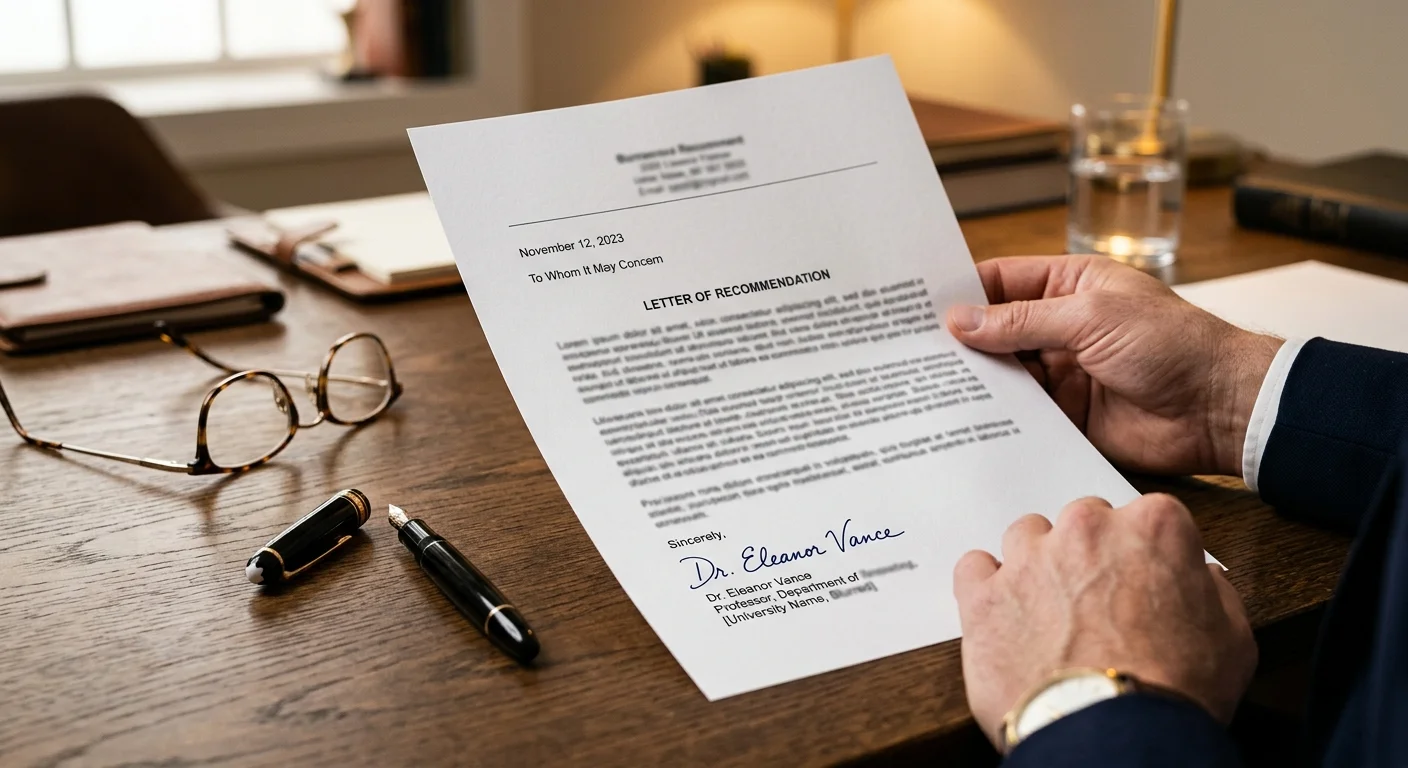
The difference between a letter that strengthens your application and one that ICA skims over often comes down to specifics. Here is what every strong PR recommendation letter should include:
- Written on official letterhead. Company letterhead for employer letters, organisation letterhead for community letters. Plain paper with no identifying marks looks unprofessional.
- States the writer's relationship to you and its duration. "I have been John's direct supervisor at ABC Pte Ltd for the past four years" is far more credible than "I know the applicant."
- Includes specific examples, not generic praise. "She led a team of 12 engineers to deliver the MRT signalling upgrade project three months ahead of schedule" tells ICA something useful. "She is a hardworking and dedicated employee" does not.
- Mentions your contributions to Singapore specifically. Training local staff, mentoring Singaporean interns, working on a national infrastructure project, volunteering at a community centre. The letter should connect your work to Singapore's benefit.
- Includes the writer's NRIC or FIN number and contact details. This shows ICA that the writer is a real, contactable person willing to stand behind their endorsement. It is not mandatory, but it adds credibility.
- Dated within the last three months. A letter dated two years ago suggests the relationship may no longer be current. Date the letter close to your application submission date.
- Signed with a wet signature. A handwritten signature (digital signatures are also acceptable) shows the writer personally endorsed the letter rather than delegating it to someone else.
- Kept to one to two pages. Concise, focused letters have more impact than long, rambling ones. ICA officers review hundreds of applications, so respect their time.
Common mistakes to avoid
Even a well-chosen recommender can hurt your application with a poorly written letter. Here are the most common mistakes that weaken recommendation letters or raise red flags with ICA officers:
Using generic template letters with no personalisation. ICA reviews thousands of PR applications each year. Officers can recognise a recycled template letter that has been used for multiple applicants with only the name swapped out. Every letter should be written specifically for your application and include details unique to you.
Asking family members to write a letter. Letters from your spouse, parents, siblings, or in-laws are not credible because ICA expects independent third-party endorsements. Family members have an obvious personal interest in your PR approval. Stick to professional contacts, community leaders, and colleagues who can provide an objective perspective.
Submitting more than three letters. Two to three well-written letters is the sweet spot. Submitting five or six does not make your application stronger; it can give the impression that you are overcompensating. Quality matters more than quantity.
Letters that contradict other application documents. If your recommendation letter states you have been in your current role for five years, but your employment history shows three years, ICA will notice the discrepancy. Make sure your recommenders have accurate information about your dates, job titles, and responsibilities before they write the letter.
Undated or unsigned letters. A letter without a date or signature looks like a draft or an afterthought. Always ensure the letter is dated (within three months of your application) and signed.
Letters written by the applicant themselves. Yes, some applicants write their own recommendation letters and ask someone else to sign them. ICA can often tell because the writing style, vocabulary, and tone match the applicant's cover letter or other submitted documents. If a recommender is too busy to write a letter themselves, it is better to provide them with bullet points about what to include and let them write it in their own words.
Sample letter structure
This article focuses on who to ask and why recommendation letters matter. But if your recommender wants a rough structure to follow, here is how a good letter typically flows. We will be publishing a dedicated employer letter template with downloadable samples in our Resources section soon.
Paragraph 1: Writer's identity and relationship
The writer introduces themselves, states their role, and explains how they know you and for how long. Example: "My name is [Name], and I am the Director of Operations at [Company]. I have been [Applicant's] direct supervisor since [Year]."
Paragraph 2: Professional contributions and character
The writer describes your specific accomplishments, skills, and work ethic. This is where concrete examples matter most. Numbers, project names, and outcomes make the letter credible.
Paragraph 3: Integration into Singapore life
The writer describes your commitment to Singapore beyond the workplace: community involvement, mentoring of local colleagues, participation in industry events, or long-term plans to stay.
Paragraph 4: Explicit endorsement
The writer clearly states their support for your PR application. A direct statement like "I strongly recommend [Applicant] for Singapore Permanent Residency" is more effective than vague well-wishes.
Closing: Contact details and signature
The writer includes their full name, designation, NRIC/FIN (if willing), phone number or email, the date, and their signature.
Frequently asked questions
Are recommendation letters required for Singapore PR applications?
No. Recommendation letters are not listed on ICA's official document checklist, so they are not a mandatory requirement. That said, they are widely considered one of the most useful optional supporting documents you can submit. ICA's checklist notes that officers "may contact the main applicant/sponsor for other supporting documents that are not listed" when assessing applications, and recommendation letters fall into this category. For a full rundown of what is required, see our PR application checklist and guide to the documents needed for a Singapore PR application.
How many recommendation letters should I submit?
Two to three well-written letters is the recommended number. Submitting just one letter is acceptable but provides limited perspective, while submitting more than three offers diminishing returns and can appear excessive. Focus on getting two to three letters from different types of recommenders (for example, one employer letter and one community leader letter) to cover different aspects of your profile.
Who should write my recommendation letter for PR?
The best recommenders are people who know you well and can speak to specific aspects of your contribution and integration in Singapore. The four main categories are: your direct employer or supervisor, business partners or clients (for self-employed applicants), community and grassroots leaders, and Singaporean colleagues or friends. Choose recommenders who can provide concrete examples rather than generic praise.
Can a family member write a recommendation letter for my PR application?
No. Family members are not considered independent third parties, and their letters lack credibility with ICA because they have a personal stake in your application outcome. Stick to professional contacts, community leaders, and colleagues who can provide an objective endorsement. Even a close friend who is a Singapore Citizen is a better choice than a family member, provided they can speak to your integration and contributions.
What format should a recommendation letter be in?
The letter should be typed (not handwritten), printed on official letterhead where possible, and saved as a PDF for submission through the e-PR system. It should be one to two pages long, dated within three months of your application submission, and signed (wet signature preferred, though digital signatures are accepted). Include the writer's full name, designation, contact details, and NRIC/FIN number if they are willing to share it.
Do recommendation letters actually improve PR approval chances?
ICA does not publicly disclose how much weight recommendation letters carry. That said, immigration consultants consistently report that strong letters can tip the balance, particularly for borderline cases. Letters provide evidence of integration and character that payslips and certificates simply cannot capture. They are especially valuable when they address factors ICA explicitly considers, such as community ties and economic contributions. The effort involved is relatively low compared to the potential upside, so most consultants recommend including them.
Strengthen your PR application with the right support
Getting the right recommendation letters is one piece of a successful PR application strategy. If you want expert guidance on preparing your complete application, including which documents to include, how to present your profile, and how to improve your PR approval chances, our team at Singapore Top Immigration can help.
We have helped hundreds of applicants through the PR process. Contact us to schedule a consultation, or explore our PR application checklist and PR application guide to start preparing today.
This article provides general guidance on recommendation letters for Singapore PR applications. Immigration policies and assessment criteria may change. Always refer to the ICA website for the most current official requirements.